 Bewise Inc. www.tool-tool.com Reference source from the internet. Silicon carbide
 (
SiC), also known as
carborundum, is a
compound of
silicon and
carbon with chemical formula SiC. It occurs in nature as the extremely rare mineral
moissanite. Silicon carbide powder has been mass-produced since 1893 for use as an
abrasive. Grains of silicon carbide can be bonded together by
sintering to form very hard
ceramics which are widely used in applications requiring high endurance, such as car brakes and
ceramic plates in
bulletproof vests. Electronic applications of silicon carbide as
light emitting diodes and
detectorsin early radios were first demonstrated around 1907, and nowadays SiC
is widely used in high-temperature/high-voltage semiconductor
electronics. Large single crystals of silicon carbide can be grown by
the Lely method; they can be cut into gems known as "synthetic
moissanite". Silicon carbide with high surface area can be produced from
SiO
2 contained in plant material.
Early,
non-systematic and often non-recognized syntheses of silicon carbide had
been reported by Despretz (1849), Marsden (1880) and Colson
(1882).Wide-scale production is credited to
Edward Goodrich Achesonaround 1893. He patented the method for making silicon carbide powder
on February 28, 1893.Acheson also developed the electric batch
furnaceby which SiC is still made today and formed The Carborundum Company to
manufacture bulk SiC, initially for use as an abrasive.In 1900 the
company settled with the
Electric Smelting and Aluminum Companywhen a judge's decision gave "priority broadly" to its founders "for
reducing ores and other substances by the incandescent method"It is said
that Acheson was trying to dissolve carbon in molten
corundum (
alumina)
and discovered the presence of hard, blue-black crystals which he
believed to be a compound of carbon and corundum: hence carborundum. Or,
he named the material "carborundum" by analogy to corundum, which is
another very hard substance (9 on the
Mohs scale).
Historically,
the first use of SiC was as an abrasive. This was followed by
electronic applications. In the beginning of the 20th century, silicon
carbide was used as a detector in the first radios,and in 1907
Henry Joseph Roundproduced the first LED by applying a voltage to a SiC crystal and
observing yellow, green and orange emission at the cathode. Those
experiments were later repeated by
O. V. Losev in the
Soviet Union in 1923.
Naturally occurring moissanite is found only in minute quantities in certain types of meteorite and in corundum deposits and
kimberlite. Virtually all the silicon carbide sold in the world, including moissanite jewels, is
synthetic. Natural moissanite was first found in 1893 as a small component of the
Canyon Diablo meteorite in
Arizona by Dr.
Ferdinand Henri Moissan,
after whom the material was named in 1905. Moissan's discovery of
naturally occurring SiC was initially disputed because his sample may
have been contaminated by silicon carbide
saw blades that were already on the market at that time.
While
rare on Earth, silicon carbide is remarkably common in space. It is a
common form of stardust found around carbon-rich stars, and examples of
this stardust have been found in pristine condition in primitive
(unaltered) meteorites. The silicon carbide found in space and in
meteorites is almost exclusively the beta-polymorph. Analysis of SiC
grains found in the Murchison carbonaceous chondrite meteorite has
revealed anomalous isotopic ratios of carbon and silicon, indicating an
origin from outside the solar system; 99% of these SiC grains originate
around carbon-rich
asymptotic giant branch stars.SiC is commonly found around these stars as deduced from their infrared spectra.
Due
to the rarity of natural moissanite, silicon carbide is typically
man-made. Most often it is used as an abrasive, and more recently as a
semiconductor and
diamond simulant of gem quality. The simplest manufacturing process is to combine
silica sand and carbon in an Acheson graphite electric resistance furnace at a high temperature, between 1600 and 2500 °C. Fine SiO
2 particles in plant material (e.g. rice husks) can be converted to SiC by heating in the excess carbon from the organic material
[13].

Synthetic SiC crystals ~3 mm in diameter
The material formed in the Acheson furnace varies in purity, according to its distance from the
graphite resistor heat source.
Colorless, pale yellow and green crystals have the highest purity and
are found closest to the resistor. The color changes to blue and black
at greater distance from the resistor, and these darker crystals are
less pure. Nitrogen and aluminium are common impurities, and they affect
the electrical conductivity of SiC.
Pure silicon carbide can be made by the so-called Lely process, in which SiC powder is sublimated in
argon atmosphere at 2500 °C and redeposited into flake-like single crystals, sized up to 2x2 cm
2,
at a slightly colder substrate. This process yields high-quality single
crystals, mostly of 6H-SiC phase (because of high growth temperature).
Cubic SiC is usually grown by the more expensive process of
chemical vapor deposition (CVD).Pure silicon carbide can also be prepared by the
thermal decomposition of a polymer,
poly(methylsilyne), under an
inert atmosphereat low temperatures. Relative to the CVD process, the pyrolysis method
is advantageous because the polymer can be formed into various shapes
prior to thermalization into the ceramic

(β)3C-SiC

4H-SiC

(α)6H-SiC
Silicon
carbide exists in about 250 crystalline forms. The polymorphism of SiC
is characterized by a large family of similar crystalline structures
called polytypes. They are variations of the same chemical compound that
are identical in two dimensions and differ in the third. Thus, they can
be viewed as layers stacked in a certain sequence.
Alpha silicon carbide (α-SiC) is the most commonly encountered
polymorph; it is formed at temperatures greater than 1700 °C and has a
hexagonal crystal structure (similar to
Wurtzite). The beta modification (β-SiC), with a
zinc blende crystal structure (similar to
diamond),
is formed at temperatures below 1700 °C. Until recently, the beta form
has had relatively few commercial uses, although there is now increasing
interest in its use as a support for heterogeneous catalysts, owing to
its higher surface area compared to the alpha form.
Properties of major SiC polytypes
Polytype
3C (β)
4H
6H (α)
Crystal structure
Zinc blende (cubic)
Hexagonal
Hexagonal
Space group
T
2d-F43m
C
46v-P6
3mc
C
46v-P6
3mc
Pearson symbolcF8
hP8
hP12
Lattice constants (Å)
4.3596
3.0730; 10.053
3.0730; 15.11
Density (g/cm
3)
3.21
3.21
3.21
Bandgap (eV)
2.36
3.23
3.05
Bulk modulus (GPa)
250
220
220
Thermal conductivity (W/(cm·K))
3.6
3.7
4.9
Pure SiC is colorless. The brown to black color of industrial product results from
iron impurities. The rainbow-like luster of the crystals is caused by a
passivation layer of
silicon dioxide that forms on the surface.
The high sublimation temperature of SiC (approximately 2700 °C) makes it useful for
bearingsand furnace parts. Silicon carbide does not melt at any known pressure.
It is also highly inert chemically. There is currently much interest in
its use as a
semiconductor material in electronics, where its high
thermal conductivity, high
electric field breakdown strength and high maximum
current density make it more promising than silicon for high-powered devices.
[23] SiC also has a very low
coefficient of thermal expansion (4.0 × 10
−6/K) and experiences no
phase transitions that would cause discontinuities in thermal expansion.
Silicon carbide is a semiconductor, which can be doped n-type by
nitrogen or
phosphorus and p-type by
aluminium,
boron,
gallium or
beryllium.
Metallic conductivity has been achieved by heavy doping with boron,
aluminium or nitrogen. Superconductivity has been detected in 3C-SiC:Al,
3C-SiC:B and 6H-SiC:B at the same temperature of 1.5 K. or aluminum.A
crucial difference is however observed for the magnetic field behavior
between aluminum and boron doping: SiC:Al is
type-II, same as Si:B. On the contrary, SiC:B is
type-I.
In attempt to explain this difference, it was noted that Si sites are
more important than carbon sites for superconductivity in SiC. Whereas
boron substitutes carbon in SiC, Al substitutes Si sites. Therefore, Al
and B "see" different environment that might explain different
properties of SiC:Al and SiC:B.
In the arts, silicon carbide is a popular abrasive in modern
lapidary due to the durability and low cost of the material. In manufacturing, it is used for its hardness in
abrasive machining processes such as
grinding,
honing,
water-jet cutting and
sandblasting. Particles of silicon carbide are laminated to paper to create
sandpapers and the grip tape on
skateboards.
In 1982 an exceptionally strong composite of
aluminium oxide and silicon carbide
whiskerswas discovered. Development of this laboratory-produced composite to a
commercial product took only three years. In 1985, the first commercial
cutting tools made from this alumina and silicon carbide
whisker-reinforced composite were introduced by the Advanced Composite
Materials Corporation (ACMC) and Greenleaf Corporation.

Silicon carbide is used for inner plates of ballistic vests
In the 1980s and 1990s, silicon carbide was studied in several research programs for high-temperature gas turbines in
Europe,
Japan and the
United States. The components were intended to replace
nickel superalloy turbineblades or nozzle vanes. However, none of these projects resulted in a
production quantity, mainly because of its low impact resistance and its
low fracture
toughness.
Like other hard ceramics (namely alumina and
boron carbide), silicon carbide is used in
composite armor (e.g.,
Chobham armor), and in ceramic plates in bulletproof vests.
Dragon Skin, which is produced by
Pinnacle Armor, uses disks of silicon carbide.
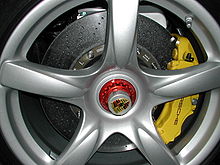
The Porsche Carrera GT's carbon-ceramic (silicon carbide) disc brake
Silicon-infiltrated
carbon-carbon composite is used for high performance "ceramic"
brake discsas it is able to withstand extreme temperatures. The silicon reacts
with the graphite in the carbon-carbon composite to become carbon fiber
reinforced silicon carbide (C/SiC). These discs are used on some road
going sports cars, including the
Porsche Carrera GT, the
Bugatti Veyron, the Chevrolet Corvette ZR1,
Bentleys,
Ferraris,
Lamborghinis, and some specific high performance
Audis.Silicon carbide is also used in a
sintered form for
diesel particulate filters.
The earliest electrical application of SiC was in
lightning arresters in electric power systems. These devices must exhibit high
resistance until the
voltage across them reaches a certain threshold
VT, at which point their resistance must drop to a lower level and maintain this level until the applied voltage drops below
VT.
It
was recognized early on that SiC had such a voltage-dependent
resistance, and so columns of SiC pellets were connected between
high-voltage
power lines and the earth. When a
lightning striketo the line raises the line voltage sufficiently, the SiC column will
conduct, allowing strike current to pass harmlessly to the earth instead
of along the power line. Such SiC columns proved to conduct
significantly at normal power-line operating voltages and thus had to be
placed
in series with a
spark gap. This spark gap is
ionizedand rendered conductive when lightning raises the voltage of the power
line conductor, thus effectively connecting the SiC column between the
power conductor and the earth. Spark gaps used in lightning arresters
are unreliable, either failing to strike an arc when needed or failing
to turn off afterwards, in the latter case due to material failure or
contamination by dust or salt. Usage of SiC columns was originally
intended to eliminate the need for the spark gap in a lightning
arrester. Gapped SiC lightning arresters were used as
lightning-protection tool and sold under
GE and
Westinghouse brand names, among others. The gapped SiC arrester has been largely displaced by no-gap
varistors that use columns of
zinc oxide pellets.
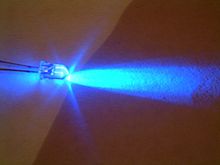
Ultraviolet LED
Silicon carbide is used for ultrafast, high-voltage
Schottky diodes,
MOSFETs and high temperature
thyristorsfor high-power switching.A major problem with SiC crystals is the
formation of different types of defect like edge dislocation, screw
dislocation (both hollow and closed core), triagular defect and basal
plane dislocation.As a result, devices made of SiC crystals show poor
breakdown performance though researchers have been tentatively finding
solutions to improving the breakdown performance.Apart from crystal
quality, problems with the interface of SiC with silicon dioxide have
hampered the development of SiC-based power MOSFETs and
insulated-gate bipolar transistors.
The
history of SiC LEDs is quite remarkable: the first LED action was
demonstrated in 1907 using SiC and the first commercial LEDs were again
based on SiC. Yellow LEDs made from 3C-SiC were manufactured in the
Soviet Union in the 1970s,and blue ones (6H-SiC) worldwide in the
1980s.The production was soon stopped because
gallium nitride showed 10-100 times brighter emission. This difference in efficiency is due to the unfavorable
indirect bandgap of SiC whereas GaN has a
direct bandgapwhich favors light emission. However, SiC is still one of the important
LED components – it is a popular substrate for growing GaN devices, and
it also serves as a heat spreader in high-power LEDs.
The low thermal expansion coefficient, high hardness, rigidity and thermal conductivity make silicon carbide a desirable
mirror material for
astronomicaltelescopes. The growth technology (chemical vapor deposition) has been
scaled up to produce disks of polycrystalline silicon carbide up to 3.5
meters in diameter, and several telescopes (like the
Herschel Space Telescope) are already equipped with SiC optics.
Main article:
Thin filament pyrometry 
Image of the test flame and glowing SiC fibers. The flame is about 7 cm tall.
Silicon carbide fibers are used to measure gas temperatures in an optical technique called
thin filament pyrometry.
It involves the placement of a thin filament in a hot gas stream.
Radiative emissions from the filament can be correlated with filament
temperature. Filaments are SiC fibers with a diameter of 15 micrometers,
that is about 5 times thinner than human hair. Because the fibers are
so thin, they do little to disturb the flame and their temperature
remains close to that of the local gas. Temperatures of about 800–2500 K
can be measured.
References to silicon carbide heating elements
exist from the early 20th century when they were produced by Acheson's
Carborundum Co. in the U.S. and EKL in Berlin. Silicon carbide offered
increased
operating temperatures compared with metallic heaters. Silicon carbide elements are used today in the melting of non-ferrous metals and glasses,
heat treatment of metals,
float glass production, production of ceramics and electronics components, igniters in
pilot lights for gas heaters, etc.
Silicon carbide is often used as a layer of the
tristructural-isotropic coating for the
nuclear fuel elements of
high temperature gas cooled reactors or
very high temperature reactors such as the
Pebble Bed Reactor.
Silicon carbide provides the mechanical stability to the fuel and is
the main diffusion barrier to the release of fission products.
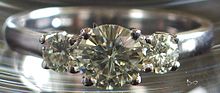
A moissanite ring
As a
gemstone used in
jewelry, silicon carbide is called "synthetic moissanite" or just "moissanite" after the mineral name. Moissanite is similar to
diamond in several important respects: it is transparent and hard (9-9.5) on the
Mohs scale (compared to 10 for diamond), with a
refractive index between 2.65 and 2.69 (compared to 2.42 for diamond). Moissanite is somewhat harder than common
cubic zirconia. Unlike diamond, moissanite can be strongly
birefringent.
This quality is desirable in some optical applications, but not in
gemstones. For this reason, moissanite jewels are cut along the
optic axis of the crystal to minimize birefringent effects. It is lighter (density 3.21 g/cm
3 vs. 3.53 g/cm
3), and much more resistant to heat than diamond. This results in a stone of higher
luster,
sharper facets and good resilience. Loose moissanite stones may be
placed directly into wax ring moulds for lost-wax casting; unlike
diamond, which burns at 800 °C, moissanite remains undamaged by
temperatures up to 1800 °C (cf. the 1064 °C melting point of pure
gold).
Moissanite has become popular as a diamond substitute, and may be
misidentified as diamond, since its thermal conductivity is much closer
to that of diamond than any other diamond substitute. Many thermal
diamond testing devices are fooled by moissanite, but the gem can be
distinguished from diamond by its
birefringenceand a very slight green or yellow fluorescence under ultraviolet light.
Some moissanite stones also have curved string-like inclusions, which
diamonds never have.
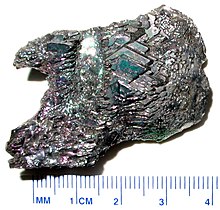
Piece of silicon carbide used in steel making
Silicon carbide dissolved in a
basic oxygen furnace used for making
steel acts as a
fuel.
It is cleaner than coal, allowing a reduction in scrap output. It can
also be used to raise tap temperatures and adjust the carbon content.
Use of silicon carbide costs less than of
ferrosilicon and carbon combination, produces cleaner steel due to low level of
trace elements, it has a low gas content and it does not lower the temperature of steel.
The
natural resistance to oxidation exhibited by silicon carbide, as well
as the discovery of new ways to synthesize the cubic β-SiC form, with
its larger surface area, has led to significant interest in its use as a
heterogeneous catalyst support. This form has already been employed as a
catalyst support for the oxidation of hydrocarbons, such as n-butane,
to maleic anhydride.
Silicon carbide is used in
carborundum printmaking – a
collagraph printmakingtechnique. Carborundum grit is applied in a paste to the surface of an
aluminium plate. When the paste is dry, ink is applied and trapped in
its granular surface, then wiped from the bare areas of the plate. The
ink plate is then printed onto paper in a rolling-bed press used for
intaglio printmaking. The result is a print of painted marks embossed
into the paper.
Silicon carbide is used to produce
grapheneby graphitization at high temperatures. This is considered as one of
the promising methods to synthesize graphene at large scale for
practical applications.
歡迎來到Bewise Inc.的世界,首先恭喜您來到這接受新的資訊讓產業更有競爭力,我們是提供專業刀具製造商,應對客戶高品質的刀具需求,我們可以協助客戶滿足您對產業的不同要求,我們有能力達到非常卓越的客戶需求品質,這是現有相關技術無法比擬的,我們成功的滿足了各行各業的要求,包括:精密HSS DIN切削刀具、協助客戶設計刀具流程、DIN or JIS 鎢鋼切削刀具設計、NAS986 NAS965 NAS897 NAS937orNAS907 航太切削刀具,NAS航太刀具設計、超高硬度的切削刀具、醫療配件刀具設計、複合式再研磨機、PCD地板專用企口鑽石組合刀具、粉末造粒成型機、主機版專用頂級電桿、PCD V-Cut刀、捨棄式圓鋸片組、粉末成型機、航空機械鉸刀、主機版專用頂級電感、’
汽車業刀具設計、電子產業鑽石刀具、木工產業鑽石刀具、
銑刀與切斷複合再研磨機、銑刀與鑽頭複合再研磨機、銑刀與螺絲攻複合再研磨機等等。我們的產品涵蓋了從民生刀具到工業級的刀具設計;從微細刀具到大型刀具;從小型生產到大型量產;全自動整合;我們的技術可提供您連續生產的效能,我們整體的服務及卓越的技術,恭迎您親自體驗!! BW Bewise Inc. Willy Chen willy@tool-tool.com bw@tool-tool.com www.tool-tool.com
skype:willy_chen_bw mobile:0937-618-190 Head &Administration Office
No.13,Shiang Shang 2nd St., West Chiu Taichung,Taiwan 40356 http://www.tool-tool.com
/ FAX:+886 4 2471 4839 N.Branch 5F,No.460,Fu Shin North
Rd.,Taipei,Taiwan S.Branch No.24,Sec.1,Chia Pu East Rd.,Taipao
City,Chiayi Hsien,Taiwan Welcome to BW
tool world! We are an experienced tool maker specialized in cutting
tools. We focus on what you need and endeavor to research the best
cutter to satisfy users’ demand. Our customers involve
wide range of industries, like mold & die, aerospace, electronic,
machinery, etc. We are professional expert in cutting field. We would
like to solve every problem from you. Please feel free to contact us,
its our pleasure to serve for you. BW product including: cutting tool、aerospace tool .HSS DIN Cutting tool、Carbide end mills、Carbide cutting tool、NAS Cutting tool、NAS986 NAS965 NAS897 NAS937orNAS907 Cutting Tools,Carbide end mill、disc milling cutter,Aerospace cutting tool、hss drill’Фрезеры’Carbide drill、High speed steel、Compound Sharpener’Milling cutter、INDUCTORS FOR PCD’
CVDD(Chemical Vapor Deposition Diamond )’PCBN (Polycrystalline Cubic Boron Nitride) ’Core drill、Tapered end mills、CVD Diamond Tools Inserts’PCD Edge-Beveling Cutter(Golden Finger’PCD V-Cutter’PCD Wood tools’PCD Cutting tools’PCD Circular Saw Blade’PVDD End Mills’diamond tool. INDUCTORS FOR PCD . POWDER FORMING MACHINE ‘Single Crystal Diamond ‘Metric end mills、Miniature end mills、Специальные режущие инструменты ‘Пустотелое сверло ‘Pilot reamer、Fraises’Fresas con mango’ PCD (Polycrystalline diamond) ‘Frese’POWDER FORMING MACHINE’Electronics cutter、Step drill、Metal cutting saw、Double margin drill、Gun barrel、Angle milling cutter、Carbide burrs、Carbide tipped cutter、Chamfering tool、IC card engraving cutter、Side cutter、Staple Cutter’PCD diamond cutter specialized in grooving floors’V-Cut PCD Circular Diamond Tipped Saw Blade with Indexable Insert’ PCD Diamond Tool’ Saw Blade with Indexable Insert’NAS tool、DIN or JIS tool、Special tool、Metal slitting saws、Shell end mills、Side and face milling cutters、Side chip clearance saws、Long end mills’
end mill grinder’drill grinder’sharpener、Stub roughing end mills、Dovetail milling cutters、Carbide slot drills、Carbide torus cutters、Angel carbide end mills、Carbide torus cutters、Carbide ball-nosed slot drills、Mould cutter、Tool manufacturer. Bewise Inc. www.tool-tool.com ようこそBewise Inc.の世界へお越し下さいませ、先ず御目出度たいのは新たな 情報を受け取って頂き、もっと各産業に競争力プラス展開。 弊社は専門なエンド・ミルの製造メーカーで、客先に色んな分野のニーズ、 豊富なパリエーションを満足させ、特にハイテク品質要求にサポート致します。 弊社は各領域に供給できる内容は: (1)精密HSSエンド・ミルのR&D (2)Carbide Cutting tools設計 (3)鎢鋼エンド・ミル設計 (4)航空エンド・ミル設計 (5)超高硬度エンド・ミル (6)ダイヤモンド・エンド・ミル (7)医療用品エンド・ミル設計 (8)自動車部品&材料加工向けエンド・ミル設計 弊社の製品の供給調達機能は: (1)生活産業~ハイテク工業までのエンド・ミル設計 (2)ミクロ・エンド・ミル~大型エンド・ミル供給 (3)小Lot生産~大量発注対応供給 (4)オートメーション整備調達 (5)スポット対応~流れ生産対応 弊社の全般供給体制及び技術自慢の総合専門製造メーカーに貴方のご体験を御待ちしております。 Bewise
Inc. talaşlı imalat sanayinde en fazla kullanılan ve üç eksende (x,y,z)
talaş kaldırabilen freze takımlarından olan Parmak Freze imalatçısıdır.
Çok geniş ürün yelpazesine sahip olan firmanın başlıca ürünlerini
Karbür Parmak Frezeler, Kalıpçı Frezeleri, Kaba Talaş Frezeleri, Konik
Alın Frezeler, Köşe Radyüs Frezeler, İki Ağızlı Kısa ve Uzun Küresel
Frezeler, İç Bükey Frezeler vb. şeklinde sıralayabiliriz. BW специализируется
в научных исследованиях и разработках, и снабжаем самым
высокотехнологичным карбидовым материалом для поставки режущих /
фрезеровочных инструментов для почвы, воздушного пространства и
электронной индустрии. В нашу основную продукцию входит твердый карбид /
быстрорежущая сталь, а также двигатели, микроэлектрические дрели, IC
картонорезальные машины, фрезы для гравирования, режущие пилы,
фрезеры-расширители, фрезеры-расширители с резцом, дрели, резаки форм
для шлицевого вала / звездочки роликовой цепи, и специальные нано
инструменты. Пожалуйста, посетите сайт www.tool-tool.com для получения большей информации. BW
is specialized in R&D and sourcing the most advanced carbide
material with high-tech coating to supply cutting / milling tool for
mould & die, aero space and electronic industry. Our main products
include solid carbide / HSS end mills, micro electronic drill, IC card
cutter, engraving cutter, shell end mills, cutting saw, reamer, thread
reamer, leading drill, involute gear cutter for spur wheel, rack and
worm milling cutter, thread milling cutter, form cutters for spline
shaft/roller chain sprocket, and special tool, with nano grade. Please
visit our web www.tool-tool.com for more info.


