 Bewise Inc. www.tool-tool.com Reference
source from the internet. Thermal spraying techniques are
coatingprocesses in which melted (or heated) materials are sprayed onto a
surface. The "feedstock" (coating precursor) is heated by electrical
(plasma or arc) or chemical means (combustion flame).
Thermal
spraying can provide thick coatings (approx. thickness range is 20
micrometers to several mm, depending on the process and feedstock), over
a large area at high deposition rate as compared to other coating
processes such as
electroplating,
physicaland
chemical
vapor deposition. Coating materials available for thermal spraying
include metals, alloys, ceramics, plastics and composites. They are fed
in powder or wire form, heated to a molten or semimolten state and
accelerated towards substrates in the form of micrometer-size particles.
Combustion or electrical arc discharge is usually used as the source of
energy for thermal spraying. Resulting coatings are made by the
accumulation of numerous sprayed particles. The surface may not heat up
significantly, allowing the coating of flammable substances.
Coating
quality is usually assessed by measuring its
porosity,
oxide content, macro
and micro-
hardness,
bond strength and
surface
roughness. Generally, the coating quality increases with increasing
particle velocities.
Several variations of thermal spraying are
distinguished:
Cold spraying Detonation spraying
Flame spraying High-velocity oxy-fuel coating
spraying (HVOF) Plasma spraying Warm spraying Wire
arc spraying In classical (developed between 1910 and
1920) but still widely used processes such as flame spraying and wire
arc spraying, the particle velocities are generally low (< 150 m/s),
and raw materials must be molten to be deposited. Plasma spraying,
developed in the 1970s, uses a high-temperature plasma jet generated by
arc discharge with typical temperatures >15000 K, which makes it
possible to spray refractory materials such as oxides,
molybdenum, etc.
A
typical thermal spray system consists of the following:
Spray
torch (or spray gun) - the core device performing the melting and
acceleration of the particles to be deposited Feeder - for
supplying the powder, wire or liquid to the torch Media
supply - gases or liquids for the
generation of the flame or plasma jet, gases for carrying the powder,
etc. Robot - for manipulating the torch or the substrates to
be coated Power supply - often standalone for the torch Control
console(s) - either integrated or individual for all of the above In plasma
spraying process, the material to be deposited (feedstock) — typically
as a
powder,
sometimes as a
liquid[2],
suspension[3]or wire — is introduced into the plasma jet, emanating from a
plasma torch. In
the jet, where the temperature is on the order of 10,000 K, the material
is melted and propelled towards a substrate. There, the molten droplets
flatten, rapidly solidify and form a deposit. Commonly, the deposits
remain adherent to the substrate as coatings; free-standing parts can
also be produced by removing the substrate. There are a large number of
technological parameters that influence the interaction of the particles
with the plasma jet and the substrate and therefore the deposit
properties. These parameters include feedstock type, plasma gas
composition and flow rate, energy input, torch offset distance,
substrate cooling, etc.
Deposit properties
The deposits
consist of a multitude of pancake-like
lamellae called
'splats', formed by flattening of the liquid droplets. As the feedstock
powders typically have sizes from micrometers to above 100 micrometers,
the lamellae have thickness in the micrometer range and lateral
dimension from several to hundreds of micrometers. Between these
lamellae, there are small voids, such as pores, cracks and regions of
incomplete bonding. As a result of this unique structure, the deposits
can have properties significantly different from bulk materials. These
are generally mechanical properties, such as lower
strength and
modulus,
higher
straintolerance, and lower
thermal and
electrical
conductivity. Also, due to the
rapid
solidification,
metastable phasescan be present in the deposits.
Applications
This
technique is mostly used to produce coatings on structural materials.
Such coatings provide protection against high temperatures (for example
thermal
barrier coatings for
exhaust heat
management),
corrosion,
erosion,
wear; they can also change
the appearance, electrical or tribological properties of the surface,
replace worn material, etc. When sprayed on substrates of various shapes
and removed, free-standing parts in the form of plates, tubes, shells,
etc. can be produced. It can be also used for powder processing
(spheroidization, homogenization, modification of chemistry, etc.). In
that case, the substrate for deposition is absent and the particles
solidify during flight or in a controlled environment (e.g., water). A
polymer dispersion aerosol could be injected into the plasma discharge
in order to create a grafting of this polymer at a substrate surface
[3].
This application is mainly used to modify the surface chemistry of
polymers.
Variations
Plasma spraying systems can be
categorized by several criteria.
Plasma jet generation: direct
current (DC plasma), where the energy is transferred to the plasma
jet by a direct current, high-power electric arc induction
plasma or RF plasma, where the energy is transferred by induction
from a coil
around the plasma jet, through which an alternating,
radio-frequency current passes Plasma-forming medium:gas-stabilized plasma (GSP), where the plasma forms from a
gas; typically argon, hydrogen, helium or their mixtures
water-stabilized plasma (WSP), where plasma forms from water (through
evaporation, dissociation and ionization) or other suitable liquid hybrid
plasma - with combined gas and liquid stabilization, typically argon
and water Spraying environment: air
plasma spraying (APS), performed in the ambient air controlled
atmosphere plasma spraying (CAPS), usually performed in a closed
chamber, either filled with inert gas or evacuated
variations of CAPS: high-pressure plasma spraying (HPPS),
low-pressure plasma spraying (LPPS), extreme case of which is vacuum plasma spraying
(VPS, see below) underwater plasma spraying Another
variation consists of having a liquid feedstock instead of a solid
powder for melt, this techniques is known as
Solution
precursor plasma spray [
edit]
Vacuum plasma spraying
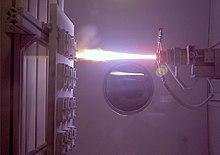 Vacuum
plasma spraying Vacuum plasma spraying (VPS) is a technology
for etching and
surfacemodification to create
porouslayers with high reproducibility and for cleaning and surface
engineering of plastics, rubbers and natural fibers as well as for
replacing
CFCs for
cleaning metal components. This surface engineering can improve
properties such as frictional behavior,
heat resistance,
surface
electrical
conductivity,
lubricity,
cohesive strength of films, or
dielectric
constant, or it can make materials
hydrophilic or
hydrophobic.
The
process typically operates at 39–120 °C to avoid thermal damage. It can
induce non-thermally activated surface reactions, causing surface
changes which cannot occur with molecular chemistries at atmospheric
pressure.
Plasma
processing is done in a controlled environment inside a sealed
chamber at a medium vacuum, around 13–65
Pa. The
gas or mixture of gases is
energized by an electrical field from
DC to
microwave frequencies,
typically 1–500 W at 50 V. The treated components are usually
electrically isolated. The volatile plasma by-products are evacuated
from the chamber by the
vacuum pump, and if
necessary can be neutralized in an exhaust
scrubber.
In
contrast to molecular chemistry, plasmas employ:
Molecular,
atomic, metastable and free radical species for chemical effects.
Positive ions and electrons for kinetic effects.

Plasma also generates
electromagnetic
radiation in the form of vacuum UV photons to penetrate bulk
polymers to a depth of about 10 µm. This can cause chain scissions and
cross-linking.
Plasmas affect materials at an atomic level.
Techniques like
X-ray
photoelectron spectroscopy and
scanning
electron microscopy are used for surface analysis to identify the
processes required and to judge their effects. As a simple indication of
surface energy,
and hence
adhesion or wettability, often a
water droplet contact
angle test is used. The lower the contact angle, the higher the
surface energy and more hydrophilic the material is.
Changing
effects with plasma
At higher energies
ionization tends to
occur more than
chemical
dissociations. In a typical reactive gas, 1 in 100 molecules form
free radicals whereas only 1 in 10
6 ionizes. The predominant effect here is
the forming of free radicals.
Ionic effects can
predominate with selection of process parameters and if necessary the
use of noble gases.
Wire arc spray
Wire arc spray is a
form of thermal spraying where two consumable metal wires are fed
independently into the spray gun. These wires are then charged and an
arc is generated between them. The heat from this arc melts the incoming
wire, which is then entrained in air jet from the gun. This entrained
molten feedstock is then deposited onto a substrate. This process is
commonly used for metallic, heavy coatings.
[1]High velocity oxygen fuel spraying (HVOF)
During the
1980s, a class of thermal spray processes called high velocity oxy-fuel
spraying was developed: A mixture of gaseous or liquid
fuel and
oxygen is fed into a
combustion chamber, where they are ignited and combusted continuously.
The resultant hot gas at a pressure close to 1 MPa emanates through a
converging–diverging nozzle and travels through a straight section. The
fuels can be gases (hydrogen, methane, propane, propylene, acetylene,
natural gas, etc.) or liquids (kerosene, etc.). The jet velocity at the
exit of the barrel (>1000 m/s) exceeds the
speed of sound. A
powder feed stock is injected into the gas stream, which accelerates
the powder up to 800 m/s. The stream of hot gas and powder is directed
towards the surface to be coated. The powder partially melts in the
stream, and deposits upon the substrate. The resulting coating has low
porosity and high
bond strength.
[1]HVOF coatings may be as thick as 12 mm (1/2"). It is typically
used to deposit
wear and
corrosion resistant coatings on materials, such as ceramic and metallic layers.
Common powders include WC-Co, chromium carbide, MCrAlY, and alumina. The
process has been most successful for depositing cermet materials
(WC–Co, etc.) and other corrosion-resistant alloys (stainless steels,
nickel-based alloys, aluminium, hydroxyapatite for medical implants,
etc.).
[1]Cold spraying

In the 1990s, cold
spraying (often called
gas dynamic
cold spray) has been introduced. The method was originally developed
in Russia with the accidental observation of the rapid formation of
coatings, while experimenting with the particle erosion of the target
exposed to a high velocity flow loaded with fine powder in a wind
tunnel. In cold spraying, particles are accelerated to very high speeds
by the carrier gas forced through a converging–diverging de Laval type
nozzle. Upon impact, solid particles with sufficient kinetic energy
deform plastically and bond mechanically to the substrate to form a
coating. The critical velocity needed to form bonding depends on the
materials properties, powder size and temperature. Soft metals such as
Cu and Al are best suited for cold spraying, but coating of other
materials (W, Ta, Ti, MCrAlY, WC–Co, etc.) by cold spraying has been
reported.
[1]The deposition efficiency is low, and the window of process
parameters and suitable powder sizes is narrow. To accelerate powders to
higher velocity, finer powders (<20 micrometers) are used. It is
possible to accelerate powder particles to much higher velocity using a
processing gas having high
speed of sound (helium instead of nitrogen). However, helium is costly and its flow
rate, and thus consumption, is higher. To improve acceleration
capability, nitrogen gas is heated up to about 900 C. As a result,
deposition efficiency and tensile strength of deposits increase.
[1]Warm spraying
Is a novel modification of high-velocity
oxy-fuel spraying, in which the temperature of combustion gas is lowered
by mixing nitrogen with the combustion gas, thus bringing the process
closer to the cold spraying. The resulting gas contains much water
vapor, unreacted hydrocarbons and oxygen, and thus is dirtier than the
cold spraying. However, the coating efficiency is higher. On the other
hand, lower temperatures of warm spraying reduce melting and chemical
reactions of the feed powder, as compared to HVOF. These advantages are
especially important for such coating materials as Ti, plastics, and
metallic glasses, which rapidly oxidize or deteriorate at high
temperatures.
[1]Applications
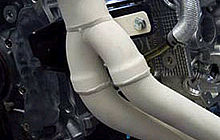
Plasma sprayed ceramic coating
applied onto a part of an automotive exhaust system
Crankshaft
reconditioning or conditioning Corrosion protection Fouling protection Altering
thermal
conductivity or electrical
conductivity Wear control: either hardfacing
(wear-resistant) or abradable coating
Repairing damaged surfaces Temperature/oxidation
protection (thermal barrier coatings) Medical implants Production
of functionally graded materials (for either of the above applications)
Safety
Thermal spraying need not be a dangerous
process, if the equipment is treated with care, and correct spraying
practices are followed. As with any industrial process, there are a
number of hazards, of which the operator should be aware, and against
which specific precautions should be taken. Ideally, equipment should be
operated automatically, in enclosures specially designed to extract
fumes, reduce noise levels, and prevent direct viewing of the spraying
head. Such techniques will also produce coatings that are more
consistent. There are occasions when the type of components being
treated, or their low production levels, requires manual equipment
operation. Under these conditions, a number of hazards, peculiar to
thermal spraying, are experienced, in addition to those commonly
encountered in production or processing industries.
Noise
Metal
spraying equipment uses compressed gases, which create noise. Sound
levels vary with the type of spraying equipment, the material being
sprayed, and the operating parameters. Typical sound pressure levels
taken 1 meter behind the arc.
UV light
Combustion
spraying equipment produces an intense flame, which may have a peak
temperature more than 3,100°C, and is very bright. Electric arc spraying
produces ultra-violet light, which may damage delicate body tissues.
Spray booths, and enclosures, should be fitted with ultra-violet
absorbent dark glass. Where this is not possible, operators, and others
in the vicinity should wear protective goggles containing BS grade 6
green glass. Opaque screens should be placed around spraying areas. The
nozzle of an arc pistol should never be viewed directly, unless it is
certain that no power is available to the equipment.
Dust and
fumes
The atomization of molten materials produces a certain
amount of dust and fumes. Proper extraction facilities are vital, not
only for personal safety, but to minimize entrapment of re-frozen
particles in the sprayed coatings. The use of breathing masks, fitted
with suitable filters, is strongly recommended, where equipment cannot
be isolated. Certain materials offer specific known hazards:
[5]Finely divided metal particles are potentially pyrophoric
and none should be allowed to accumulate. Certain materials
e.g. aluminum, zinc and other base metals may react with water to evolve
hydrogen. This is potentially explosive and special precautions are
necessary in fume extraction equipment. Fumes of certain
materials, notably zinc and copper alloys are unpleasant to smell, and,
in certain individuals, may cause a fever-type reaction. This may occur
some time after spraying and usually subsides rapidly. If it does not,
medical advice must be sought. Heat
Combustion
spraying guns use oxygen and fuel gases. The fuel gases are potentially
explosive. In particular, acetylene may only be used under approved
conditions. Oxygen, while not explosive, will sustain combustion, and
many materials will spontaneously ignite, if excessive oxygen levels are
present. Care must be taken to avoid leakage, and to isolate oxygen and
fuel gas supplies, when not in use.
[5]Shock hazards
Electric arc guns operate at low
voltages (below 45 V dc), but at relatively high currents. They may be
safely hand-held. The power supply units are connected to 440 V AC
sources, and must be treated with caution.
歡迎來到Bewise Inc.的世界,首先恭喜您來到這接受新的資訊讓產業更有競爭
力,我們是提供專業刀具製造商,應對客戶高品質的刀具需求,我們可以協助客戶滿足您對產業的不同要求,我們有能力達到非常卓越的客戶需求品
質,這是現有相關技術無法比擬的,我們成功的滿足了各行各業的要求,包括:精密HSS DIN切削刀具、協助客戶設計刀具流程、DIN or JIS 鎢鋼切削刀具設計、NAS986 NAS965 NAS897 NAS937orNAS907 航太切削刀具,NAS航太刀具設計、超高硬度的切削刀具、醫療配件刀具設計、複合式再研磨機、PCD地板專用企口鑽石組合刀
具、粉末造粒成型機、主機版專用頂級電桿、PCD V-Cut刀、捨棄式圓鋸片組、粉末成型機、主機版專用頂級電感、’
汽車業刀具設計、電子產業鑽石刀具、木工產業鑽石刀具、
銑刀與切斷複合再研磨機、銑刀與鑽頭複合再研磨機、銑刀與螺絲攻複合再研磨機等等。我們的產品涵蓋了從民生
刀具到工業級的刀具設計;從微細刀具到大型刀具;從小型生產到大型量產;全自動整合;我們的技術可提供您連續生產的效能,我們整體的服務及卓越的技術,恭
迎您親自體驗!! BW
Bewise Inc. Willy Chen willy@tool-tool.com bw@tool-tool.com www.tool-tool.com
skype:willy_chen_bw mobile:0937-618-190 Head &Administration Office
No.13,Shiang Shang 2nd St., West Chiu Taichung,Taiwan 40356 http://www.tool-tool.com /
FAX:+886 4 2471 4839 N.Branch 5F,No.460,Fu Shin North Rd.,Taipei,Taiwan
S.Branch No.24,Sec.1,Chia Pu East Rd.,Taipao City,Chiayi Hsien,TaiwanWelcome to BW
tool world! We are an experienced tool maker specialized in cutting
tools. We focus on what you need and endeavor to research the best
cutter to satisfy users’ demand. Our customers involve
wide range of industries, like mold & die, aerospace, electronic,
machinery, etc. We are professional expert in cutting field. We would
like to solve every problem from you. Please feel free to contact us,
its our pleasure to serve for you. BW product including: cutting tool、aerospace tool .HSS DIN Cutting tool、Carbide end mills、Carbide cutting tool、NAS Cutting tool、NAS986 NAS965 NAS897 NAS937orNAS907 Cutting Tools,Carbide end mill、disc milling cutter,Aerospace
cutting tool、hss
drill’Фрезеры’Carbide drill、High speed steel、Compound Sharpener’Milling cutter、INDUCTORS FOR PCD’
CVDD(Chemical Vapor Deposition
Diamond )’PCBN
(Polycrystalline Cubic Boron Nitride) ’Core drill、Tapered end
mills、CVD Diamond
Tools Inserts’PCD
Edge-Beveling Cutter(Golden Finger’PCD V-Cutter’PCD Wood tools’PCD Cutting tools’PCD Circular Saw Blade’PVDD End Mills’diamond tool. INDUCTORS FOR PCD .POWDER FORMING MACHINE
‘Single Crystal
Diamond ‘Metric
end mills、Miniature
end mills、Специальные
режущие инструменты ‘Пустотелое сверло
‘Pilot reamer、Fraises’Fresas con mango’
PCD (Polycrystalline
diamond) ‘Frese’POWDER
FORMING MACHINE’Electronics cutter、Step drill、Metal cutting saw、Double margin drill、Gun barrel、Angle milling cutter、Carbide burrs、Carbide tipped cutter、Chamfering tool、IC card engraving cutter、Side cutter、Staple Cutter’PCD diamond cutter specialized in
grooving floors’V-Cut
PCD Circular Diamond Tipped Saw Blade with Indexable Insert’PCD Diamond Tool’Saw Blade with Indexable Insert’NAS tool、DIN or JIS tool、Special tool、Metal slitting saws、Shell end mills、Side and face milling cutters、Side chip clearance saws、Long end mills’
end mill grinder’drill grinder’sharpener、Stub roughing end mills、Dovetail milling cutters、Carbide slot drills、Carbide torus cutters、Angel carbide end mills、Carbide torus cutters、Carbide ball-nosed slot drills、Mould
cutter、Tool manufacturer. Bewise Inc. www.tool-tool.com よ
うこそBewise Inc.の
世界へお越し下さいませ、先ず御目出度たいのは新たな 情報を受け取って頂き、もっと各産業に競争力プラス展開。弊社は専門なエンド・ミルの製造メーカーで、客先に色んな分野のニーズ、 豊富なパリエーションを満足させ、特にハイテク品質要求にサポート致します。 弊社は各領域に供給
できる内容は: (1)精密
HSSエンド・ミルのR&D (2)Carbide Cutting tools設計(3)鎢鋼エンド・ミ
ル設計 (4)航空エ
ンド・ミル設計 (5)超高硬度エンド・ミル (6)ダイヤモンド・エンド・ミ
ル (7)医療用品エ
ンド・ミル設計 (8)自動車部品&材料加工向けエンド・ミル設計弊社の製品の供給調達機能は: (1)生活産業~ハイテク工業までのエンド・ミル設計(2)ミクロ・エ
ンド・ミル~大型エンド・ミル供給 (3)小Lot生産~大量発注対応供給 (4)オートメーション整備調達 (5)スポット対応~流れ生産対応 弊社
の全般供給体制及び技術自慢の総合専門製造メーカーに貴方のご体験を御待ちしております。 Bewise
Inc. talaşlı imalat sanayinde en fazla kullanılan ve üç eksende (x,y,z)
talaş kaldırabilen freze takımlarından olan Parmak Freze imalatçısıdır.
Çok geniş ürün yelpazesine sahip olan firmanın başlıca ürünlerini
Karbür Parmak Frezeler, Kalıpçı Frezeleri, Kaba Talaş Frezeleri, Konik
Alın Frezeler, Köşe Radyüs Frezeler, İki Ağızlı Kısa ve Uzun Küresel
Frezeler, İç Bükey Frezeler vb. şeklinde sıralayabiliriz. BW специализируется в
научных исследованиях и разработках, и снабжаем самым
высокотехнологичным карбидовым материалом для поставки режущих /
фрезеровочных инструментов для почвы, воздушного пространства и
электронной индустрии. В нашу основную продукцию входит твердый карбид /
быстрорежущая сталь, а также двигатели, микроэлектрические дрели, IC
картонорезальные машины, фрезы для гравирования, режущие пилы,
фрезеры-расширители, фрезеры-расширители с резцом, дрели, резаки форм
для шлицевого вала / звездочки роликовой цепи, и специальные нано
инструменты. Пожалуйста, посетите сайт www.tool-tool.com для
получения большей информации. BW is specialized in
R&D and sourcing the most advanced carbide material with high-tech
coating to supply cutting / milling tool for mould & die, aero space
and electronic industry. Our main products include solid carbide / HSS
end mills, micro electronic drill, IC card cutter, engraving cutter,
shell end mills, cutting saw, reamer, thread reamer, leading drill,
involute gear cutter for spur wheel, rack and worm milling cutter,
thread milling cutter, form cutters for spline shaft/roller chain
sprocket, and special tool, with nano grade. Please visit our web www.tool-tool.com
for more info.


